
The OEM’s Blind Spot
For an OEM or brand, primary sales are only half the picture. You may know what you shipped to distributors, but do you know what actually sold to retailers? Where inventory is accumulating? Which SKUs are moving or ageing?
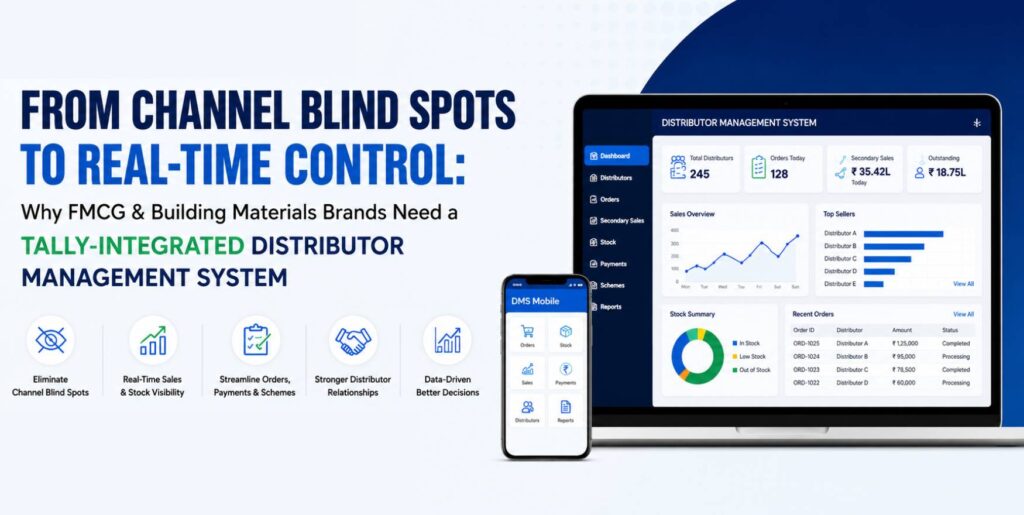
Which distributors are facing stock-outs? Are trade schemes being claimed accurately? Without timely distributor-level data, the channel becomes a black box. Brands rely on periodic reports, spreadsheets and manual reconciliation, creating blind spots in secondary sales, phantom inventory, replenishment and claims. A Distributor Management System (DMS) closes this visibility gap by connecting the brand with distributor operations and creating a centralized view of sales, inventory, schemes, claims and channel performance. But there is one critical challenge: distributor adoption.
Why DMS + Distributor Tally Integration Matters
Most distributors already run their accounting, billing and inventory operations through systems such as Tally. Asking them to enter the same transaction into both Tally and a DMS creates duplicate work, delays and resistance. The answer is not to replace the distributor’s existing system. It is to connect it. A Tally-integrated DMS allows distributors to continue using their familiar accounting workflow while automatically making relevant sales, stock, invoice and return data available to the OEM. This creates a powerful model: Tally remains the distributor’s operational system.
DMS has become the OEM’s channel intelligence and governance layer. The result is better distributor adoption for the brand and far richer downstream visibility without forcing distributors to rebuild their processes.
5 Strategic Benefits for the OEM
- Live Secondary Sales Visibility
Primary sales tell you what the OEM sold to the distributor. Secondary sales tell you what the distributor sold into the market. A Tally-integrated DMS can give sales teams visibility into distributor and retailer-level movement, SKU velocity, territory performance and consumption trends. Instead of mistaking channel loading for genuine demand, brands can make decisions based on actual market movement.
- True Stock & Expiry Tracking
Knowing what was shipped is not the same as knowing where inventory is today
- Excess inventory and emerging stock-outs
- Fast- and slow-moving SKUs
- Distributor-level stock positions
- Ageing and expiry risks
- Regional inventory imbalances
This enables proactive replenishment, redistribution and stock rotation particularly valuable in categories where shelf life and working capital matter.
- Faster, Automated Claims Settlement
Trade schemes and distributor claims become difficult to manage when eligibility, sales data and supporting documents are reconciled manually. A DMS can connect scheme rules with actual distributor transactions, creating a more structured process for claim validation, approval and settlement. This reduces manual effort, disputes and reconciliation gaps while improving auditability and transparency across the channel.
- Production & Demand Forecasting
When OEMs see only primary sales, forecasting is based largely on what distributors purchased. When distributor-level consumption and inventory data becomes available, brands gain stronger demand signals. Sales, supply chain and production teams can use this intelligence to improve:
- Production planning
- Inventory allocation
- Replenishment
- Logistics prioritization
- Working-capital management
The DMS therefore becomes more than a sales tool—it becomes a source of downstream demand intelligence for the supply chain.
- Frictionless Distributor Adoption
The best DMS is ineffective if distributors do not use it consistently. Tally integration removes one of the biggest adoption barriers: duplicate data entry. Instead of asking distributors to abandon their existing accounting workflow, the OEM can connect the DMS to it. Relevant transactions flow automatically, reducing operational friction while giving the brand the structured data it needs. Lower distributor effort + higher data availability = stronger DMS adoption.
How the Tally–DMS Sync Works
The integration creates a bidirectional data bridge between the distributor’s Tally environment and the OEM’s DMS. From Tally → DMS, relevant information such as sales invoices, sales quantities, stock, purchases, returns and retailer transactions can flow automatically into the central platform. From DMS → Tally, approved information such as product masters, price lists, customer masters, schemes and other relevant data can be pushed back to the distributor. The exact data exchanged depends on the OEM’s processes and integration architecture, but the objective is simple: eliminate duplicate entry while creating a connected flow of channel data.
From Reactive Distribution to Intelligent Channel Management
For OEMs managing large distributor networks, the objective is no longer simply to move more products into the channel. It is to understand what happens after the shipment and act on that intelligence faster. A DMS provides the control layer. Tally integration makes that layer scalable by connecting the OEM to distributor data without disrupting existing workflows. For FMCG, consumer goods, pharma and other distribution-intensive businesses, the result is a shift from: : Delayed reports → Manual reconciliation → Reactive decisions to: Connected data → Real-time visibility → Proactive action if your brand still relies on periodic distributor reports to understand secondary sales, inventory and channel performance, it is time to rethink your distribution architecture. Explore how a Tally-integrated DMS can turn distributor data into a strategic advantage.
FAQs
1. What is a Tally-integrated DMS?
A Tally-integrated DMS connects distributor Tally data with the OEM’s DMS for seamless sales, inventory, claims and channel visibility.
2. How does Tally-DMS integration benefit OEMs?
It provides real-time secondary sales visibility, stock tracking, demand insights and better channel management.
3. Does distributor need to enter data twice?
No. Integration reduces duplicate data entry by automatically syncing relevant information between Tally and the DMS.
4. Can OEMs track distributor inventory and stock-outs?
Yes. OEMs can monitor distributor-level stock, fast- and slow-moving SKUs, ageing inventory and potential stock-outs.
5. How does DMS improve distributor adoption?
By integrating with Tally, distributors can continue their existing workflows while sharing relevant data with the OEM automatically.